Back in the old days, people used to leave comments on blogs. Imagine such a time. One time a guy even sent me a bottle of his homemade wine in appreciation for a post I made about getting MinionPro fonts to work in LaTeX!
My own blog has migrated from Wordpress (self-hosted), to Haskell/Yesod (custom framework, self-hosted), and finally to Github static pages.
Wordpress handled comments, so that was easy. Some 10+ years ago when I moved to the custom Yesod blog I wrote my own comment system. It looks like it was fairly static, I certainly didn’t write any JavaScript to give the UI any juice.
Eventually I got sick of self-hosting and switched to a Hugo blog on GitHub pages. Despite blog comment traffic dropping nearly to zero, I decided to write a blog comment system using Elm on the frontend and Go on the backend.
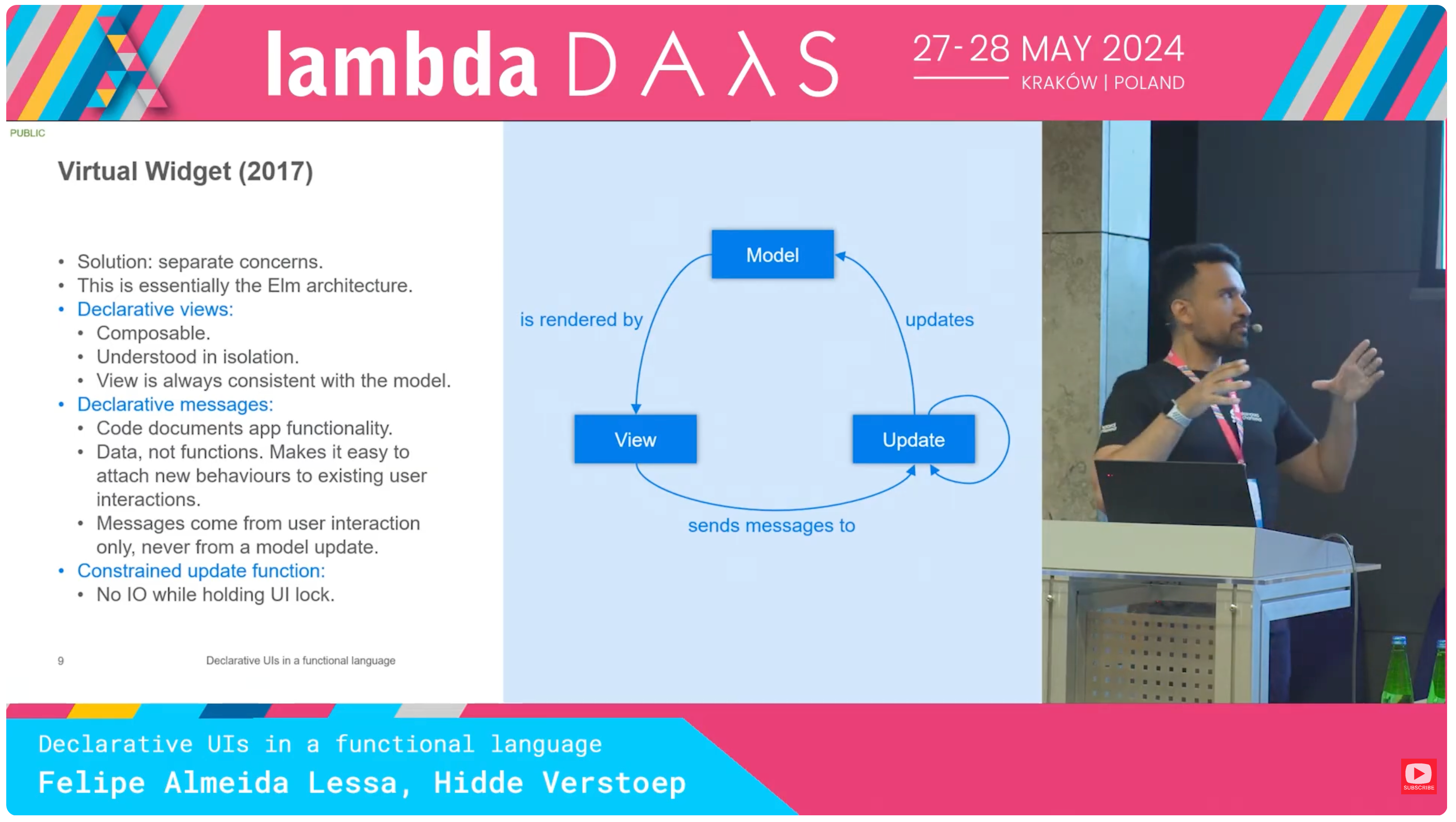
It was an interesting experience writing Elm after having written View2 apps when I was a Strat at Standard Chartered. My erstwhile colleague Felipe Almeida Lessa talked about View2 at Lambda Days 2024:
I’m amazed that some of the detail escaped the event horizon that is bank compliance.
As he explained, View2 was essentially the Elm architecture:
Bubble Tea also copies the Elm architecture, and that’s a fun way to make TUIs in Go. The only downside is that, being Go, one can do anything anywhere since there isn’t a type system constraining where you can run IO actions and so on.
Elm+Go blog comment system Link to heading
My Elm code has a standard
sort of Model, capturing all the runtime state:
type alias Model =
    { lc : State LoadedComments
    , currentUrl : Url.Url
    , author : String
    , authorEmail : String
    , commentBody : String
    , submitStatus : SubmitStatus
    , turnstileToken : Maybe String
    }
This captures front end state like whether the user has clicked submit, successfully clicked submit, had a failure, etc.
We are forced to model the complement as well, NotSubmitted, meaning the user is still editing:
type SubmitStatus
    = NotSubmitted
    | Submitting
    | SubmitSuccess
    | SubmitFailure String
The LoadedComments type was essentially a list of Comment:
type alias Comment t =
    { commentID : String
    , siteID : String
    , postID : String
    , timestamp : t
    , author : String
    , authorEmail : String
    , commentBody : String
    , isActive : Bool
    }
Elm is on the browser, so it has to communicate with the Go backend via some kind of encoding, and the easiest thing that everyone reaches for is JSON:
encodeComment : Model -> Encode.Value
encodeComment model =
    Encode.object
        [ ( "siteID", Encode.string theSiteId )
        , ( "postID", Encode.string (trimTrailingSlashes model.currentUrl.path) )
        , ( "author", Encode.string model.author )
        , ( "authorEmail", Encode.string model.authorEmail )
        , ( "commentBody", Encode.string model.commentBody )
        , ( "turnstileToken", Encode.string (Maybe.withDefault "" model.turnstileToken) )
        ]
At the core of any Elm/View2 application is a message type; sometimes these became nested and quite exciting to handle (profunctors, profunctors everywhere!). For the blog comment system we had:
type Msg
    = GotComments (Result Http.Error (List (Comment Int)))
    | UpdateAuthor String
    | UpdateAuthorEmail String
    | UpdateCommentBody String
    | SubmitForm
    | GotSubmitResponse (Result Http.Error ())
    | TurnstileToken String
Handling all of these cases is the job of the update function:
update : Msg -> Model -> ( Model, Cmd Msg )
update msg model =
    case msg of
        UpdateAuthor newAuthor ->
            ( { model | author = newAuthor }, Cmd.none )

        UpdateAuthorEmail newEmail ->
            ( { model | authorEmail = newEmail }, Cmd.none )

        UpdateCommentBody newBody ->
            ( { model | commentBody = newBody }, Cmd.none )

        GotComments result ->
            case result of
                Ok data ->
                    let
                        parsedComments =
                            List.map
                                (\comment ->
                                    { commentID = comment.commentID
                                    , siteID = comment.siteID
                                    , postID = comment.postID
                                    , author = comment.author
                                    , authorEmail = comment.authorEmail
                                    , timestamp = Time.millisToPosix comment.timestamp
                                    , commentBody = comment.commentBody
                                    , isActive = comment.isActive
                                    }
                                )
                                data
                    in
                    ( { model | lc = Success { allComments = parsedComments, unmoderated = [] } }, Cmd.none )

                Err e ->
                    ( { model | lc = Failure (errorToString e) }, Cmd.none )

        SubmitForm ->
            ( { model | submitStatus = Submitting }
            , submitComment model
            )

        GotSubmitResponse result ->
            case result of
                Ok _ ->
                    ( { model | submitStatus = SubmitSuccess }, Cmd.none )

                Err error ->
                    ( { model | submitStatus = SubmitFailure (errorToString error) }, Cmd.none )

        TurnstileToken token ->
            ( { model | turnstileToken = Just token }, Cmd.none )
Phew!
On the Go side of things we have to deserialise the JSON, perform database updates, and let the Elm front end know what happened.
There’s duplication here, because we’ve implemented a Comment type in Elm, then a JSON representation, and then an equivalent type for the backend:
type Comment struct {
	CommentID     string    `json:"commentID"`
	SiteID        string    `json:"siteID"`
	PostID        string    `json:"postID"`
	Timestamp     Timestamp `json:"timestamp"`
	SourceAddress string    `json:"sourceAddress"`
	Author        string    `json:"author"`
	AuthorEmail   string    `json:"authorEmail"`
	CommentBody   string    `json:"commentBody"`
	IsActive      bool      `json:"isActive"`
}
But that’s not quite right - we don’t have a PostID when a user submits a comment, so we also need an intermediate type:
type NewComment struct {
	SiteID         string `json:"siteID"`
	PostID         string `json:"postID"`
	Author         string `json:"author"`
	AuthorEmail    string `json:"authorEmail"`
	CommentBody    string `json:"commentBody"`
	TurnstileToken string `json:"turnstileToken"`
}
It just doesn’t feel good implementing similar yet different types for the same thing across the backend and front end, plus adding serialisation in between.
The Elm compiles to a 455K JavaScript file! 🤯
Datastar Link to heading
I rewrote the Elm/Go system in Datastar/Go
Let’s walk through it.
The core of the Hugo comment template is the comments block:
<section id="comments"
         data-on-intersect__once="@get('https://comments.carlo-hamalainen.net/comments/v1/list?postID={{ strings.TrimSuffix "/" .RelPermalink }}')">
  <p>Loading comments…</p>
</section>
The attribute data-on-intersect__once is where the current
comments will appear; initially the user sees Loading comments... and the Go backend will morph the id="comments" HTML
using an SSE patch.
The next block is for the comment form, and it involves a Cloudflare Turnstile widget, so here it is in full:
<div data-signals="{widgetId: '', turnstileToken: '', name: '', comment: '', submitting: false }">

  <div id="turnstile-container"
       data-init=
          "$widgetId = turnstile.render('#turnstile-container',
              { sitekey: '0x4AAAAAAAfct15KixMdrAXv',
                callback: (token) => $turnstileToken = token
              })"
  >
  </div>

  <p data-show="$turnstileToken === ''">Comment form pending Cloudflare verification...</p>

  <form id="myform" data-show="$turnstileToken" style= "display: none" name="myform">
    <input type="hidden" name="cf-turnstile-response" data-bind= "turnstileToken">
    <input type="hidden" name="postID" value="{{ strings.TrimSuffix "/" .RelPermalink }}">


    <p><label for="name">Name (required):</label><br>
    <input type="text" id="name" name="name" required="" data-bind="name"></p>

    <p><label for="email">Email (optional):</label><br>
    <input type="email" id="email" name="email"></p>

    <p><label for="comment">Comment:</label><br>
    <textarea id="comment" name="comment" rows="8" cols="50" required="" data-bind="comment"></textarea></p>

    <button type="submit"
      data-indicator:submitting
      data-attr:disabled="!$name.trim() || !$comment.trim() || $submitting"
      data-on:click__prevent="@post('https://comments.carlo-hamalainen.net/comments/v1/new', {contentType: 'form'})"
      >
      Submit comment</button>

    <span class="submitting-indicator" data-show="$submitting">Submitting...</span>
  </form>

  <div id="comment-status"></div>

</div>
Walking through this: first we declare our signals:
<div data-signals="{widgetId: '', turnstileToken: '', name: '', comment: '', submitting: false }">
widgetId is the ID of the Cloudflare Turnstile widget; turnstileToken is
the token they return on successful human validation; name and comment are
for the content of the form fields.
The form itself is only visible when the user has validated with the Cloudflare
Turnstile (i.e. the signal turnstileToken is not ''); for this we
use data-show:
<form id="myform" data-show="$turnstileToken" style="display: none" name="myform">
We bind the content of the name field to the signal name using
data-bind:
<input type="text" id="name" name="name" required="" data-bind="name"></p>
In this way, we can disable the submit button if $name.trim() is empty; and similar for the
comment field.
We use data-indicator to disable the submit button while
the POST is in flight; and the action of the button itself is defined using
data-on:click and the @post action.
    <button type="submit"
      data-indicator:submitting
      data-attr:disabled="!$name.trim() || !$comment.trim() || $submitting"
      data-on:click__prevent="@post('https://comments.carlo-hamalainen.net/comments/v1/new', {contentType: 'form'})"
      >
      Submit comment</button>
On the backend we have a single type for a comment:
type comment struct {
	commentID     string
	siteID        string
	postID        string
	timestampMS   int64
	timestamp     time.Time
	sourceAddress string
	author        string
	authorEmail   string
	comment       string
	isActive      bool
}
The HTTP handler for the comments on a page is remarkably short - it just loads the comments from SQLite, and then in hypermedia style it produces the HTML and patches the comments element:
func handleList(w http.ResponseWriter, r *http.Request) {
	postID := r.URL.Query().Get("postID")
	if postID == "" {
        // error case...
		return
	}

	sse := datastar.NewSSE(w, r)

	// read comments from SQLite
	comments, err := getVisibleComments(r.Context(), postID)
	if err != nil {
		// error case...
		return
	}

	var buf bytes.Buffer
	if len(comments) == 0 {
		buf.WriteString(`<p>No comments yet.</p>`)
	} else {
		buf.WriteString(`<h2 class="comments-heading">Comments</h2>`)
		for _, c := range comments {
			writeCommentHTML(&buf, c)
		}
	}

	sse.PatchElements(buf.String(), datastar.WithSelectorID("comments"), datastar.WithModeInner())
}
We could use templating (tmpl? gomponents?) but the HTML is so short it can be done in an Fprintf:
func writeCommentHTML(w io.Writer, c comment) {
	fmt.Fprintf(w, `<article class="comment">
  <header><span class="comment-author">%s</span> <time datetime="%s">%s</time></header>
  <div class="comment-body">%s</div>
</article>
`,
		html.EscapeString(c.author),
		c.timestamp.Format(time.RFC3339),
		c.timestamp.Format("2 Jan 2006"),
		renderCommentMarkdown(c.comment),
	)
}
That’s it!
Load the comments from SQLite, produce the HTML fragments, and patch them in with SSE. No serialising and deserialising, no alternative almost-the-same-but-not-quite representation in the front end.
So simple!
The Elm+Go version was a bit more general, supporting multiple backends (SQLite, S3, DynamoDB), but even being conservative and ignoring the non-SQLite backends, the Elm+Go version is over 2000 lines of code:
     761 carlo-comments/admin/src/Main.elm
     275 carlo-comments/api/server/comment.go
      19 carlo-comments/api/server/context.go
     139 carlo-comments/api/server/email.go
      23 carlo-comments/api/server/errors.go
      72 carlo-comments/api/server/middlewares.go
      60 carlo-comments/api/server/routes.go
     182 carlo-comments/api/server/server.go
      47 carlo-comments/api/server/turnstile.go
     100 carlo-comments/api/server/urls.go
      44 carlo-comments/api/server/user.go
      92 carlo-comments/api/server/utils.go
     130 carlo-comments/api/sqlite/comment.go
      47 carlo-comments/api/sqlite/db.go
       1 carlo-comments/api/sqlite/user.go
      53 carlo-comments/api/main.go

    2045 total
Meanwhile the Go+Datastar version is just over 800 lines, and that includes a fully functional admin page, something I never got around to doing properly in the old Elm version.
     680 carlo-comments-ds/main.go
     131 carlo-comments-ds/carlohamalainen.github.io/layouts/partials/posts/carlo-comments-ds.html
     811 total
The real win is removing duplicated data structures and intermediate representations of the data (the JSON form).
Epilogue Link to heading
Datastar is my framework of choice for building reactive web apps 🚀
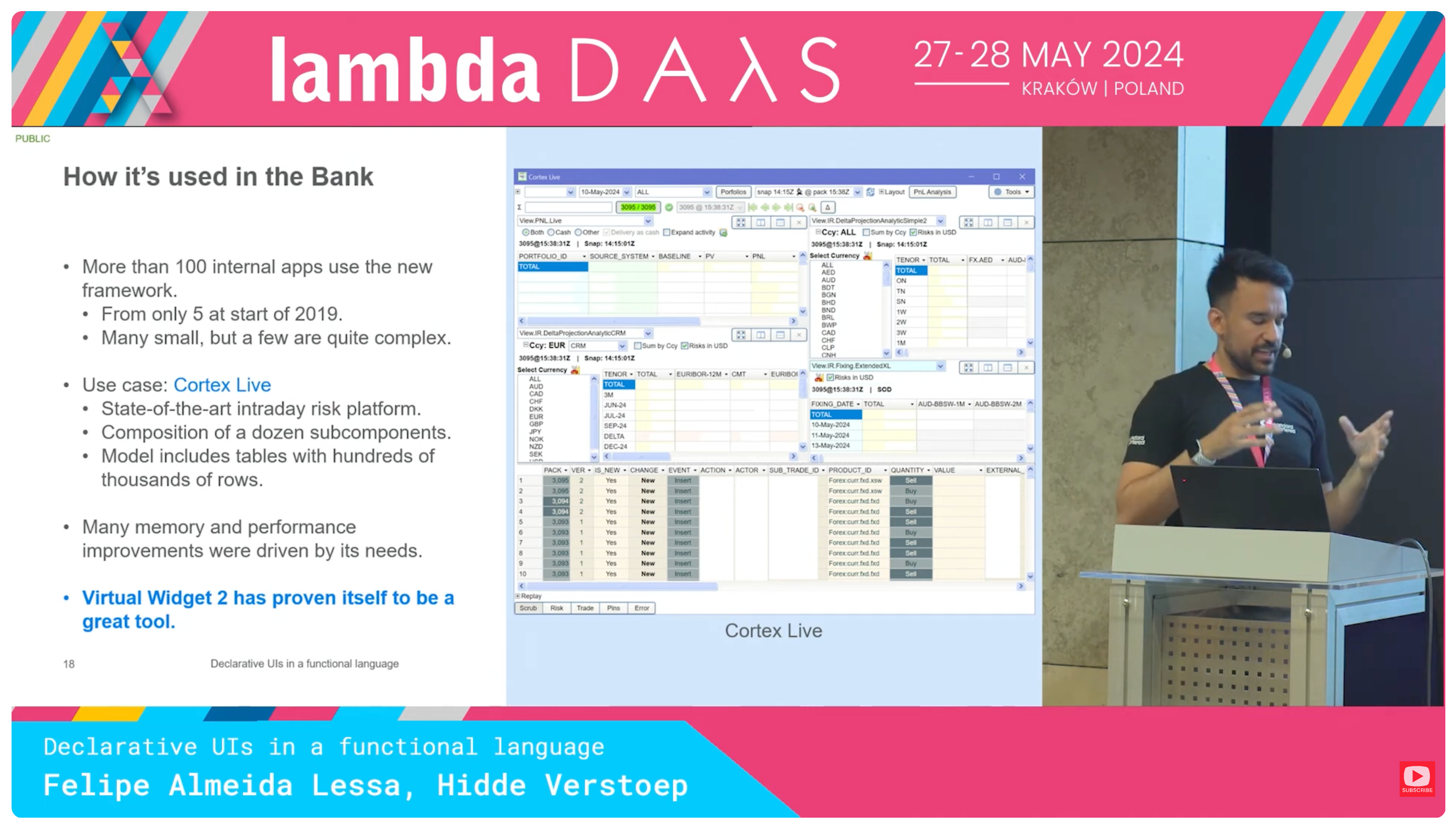
I wonder if Cortex Live would benefit from a hypermedia/Datastar approach? 🤔
One benefit of the Datastar architecture is the easy “god mode” view; since state is all on the server it is easy to create admin views of what users are actually doing. Having users on a web browser instead of a desktop application also removes the labour of making users to update a desktop client. Traders are busy but even they can manage Ctrl-R during business hours.
Comment form pending Cloudflare verification...
Loading comments…