What better way to learn Lean than to implement a bespoke home battery management system? I’m going to do that in this series of blog posts, porting my Go implementation over to Lean4. The UI will naturally use the Lean Datastar SDK that I developed with Valentin Erokhin. Also check out https://leangineer.com 🙂
I couldn’t find a Modbus library in Lean, but it’s a fairly simple protocol, so I wrote my own from scratch. First we need a header type:
structure Header where
  tx       : UInt16
  protocol : UInt16
  length   : UInt16
  unit     : UInt8
  deriving Repr, BEq
The fields:
tx: client chooses and the server echoes back; used for synchronisation.protocol: the protocol identifier; for Modbus/TCP this is always zero.length: Number of remaining bytes in this frame.unit: Server address. For Sungrow this seems to be 1 by default.
Encoding the header and proving its size Link to heading
Here’s a small helper for appending a 16-bit word to a ByteArray (Modbus is big-endian).
def putU16 (b : ByteArray) (v : UInt16) : ByteArray :=
  let vHigh := (v >>> 8).toUInt8
  let vLow  := v.toUInt8
  b.push vHigh |>.push vLow
Now we can define the encoder which converts a Header to a ByteArray:
def Header.encode (h : Header) : ByteArray :=
  ByteArray.empty
    |> (putU16 · h.tx)
    |> (putU16 · h.protocol)
    |> (putU16 · h.length)
    |> (.push · h.unit)
The quirky dot notation · is a nice shorthand for what one would write in Haskell as \x -> putU16 x h.tx.
Perhaps taking inspiration from F#, Lean has some nice pipe operators like |> where
x |> f means the same as f x, and it associates to the left so that x |> f |> g is
g (f x).
We declare that the size of Header is 7 bytes:
def Header.size : Nat := 7Magic numbers like this are always fun in huge codebases. Someone adds a field
to Header, and then everything explodes. So let’s prove that Header has size
7!
theorem Header.size_encode (h : Header) : h.encode.size = Header.size := by
  sorry
We are declaring a theorem size_encode on Header; its one hypothesis is that h is a
Header and the goal is that h.encode.size = Header.size. We don’t know what to do so we
write sorry for the proof body.
If you put the cursor at the start of sorry, the Lean Info View will show the current tactic state:
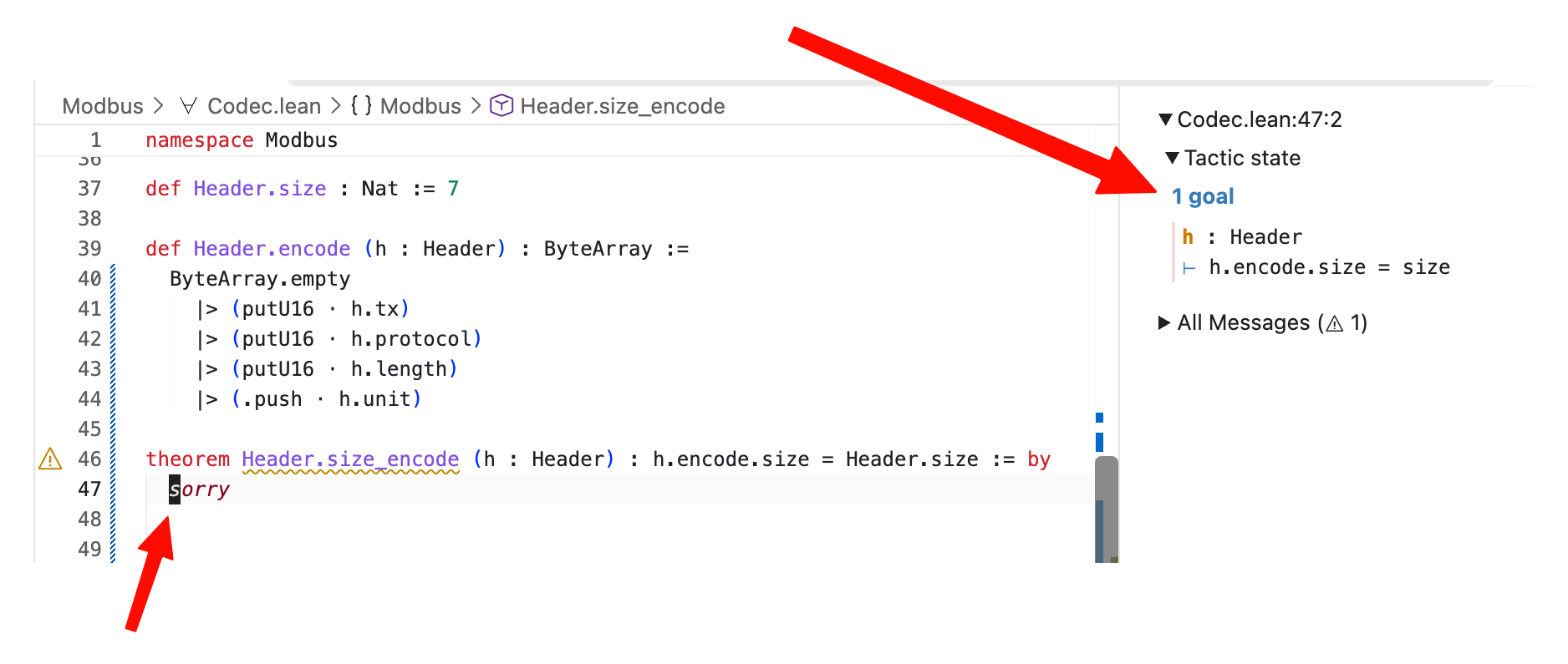
We know that h is a Header, and we need to show that h.encode.size = size.
First let’s try the simplifier simp:
theorem Header.size_encode (h : Header) : h.encode.size = Header.size := by
  simp
This doesn’t help:
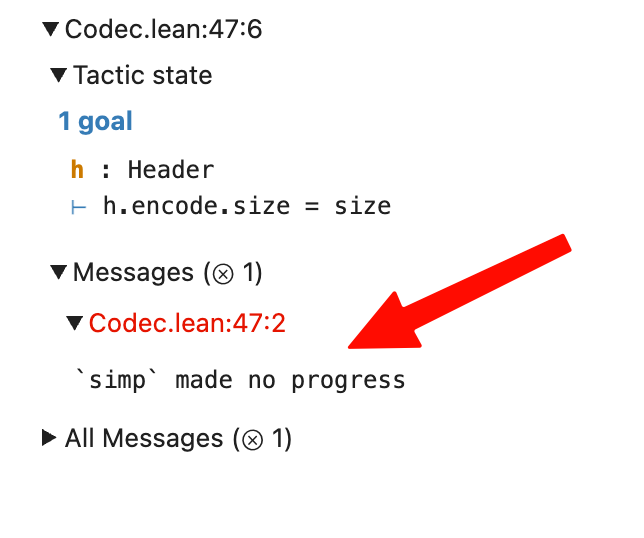
If you were doing this with pen and paper, you’d make the first (and only?) sensible
move which is to expand the definition of Header.encode, so let’s try that:
theorem Header.size_encode (h : Header) : h.encode.size = Header.size := by
  simp [Header.encode]
Progress!
1 goal
h : Header
⊢ (putU16 (putU16 (putU16 ByteArray.empty h.tx) h.protocol) h.length).size + 1 = size
Again our only move is to expand a definition, so we add putU16 to the simp tactic:
theorem Header.size_encode (h : Header) : h.encode.size = Header.size := by
  simp [Header.encode, putU16]
We are tantalisingly close:
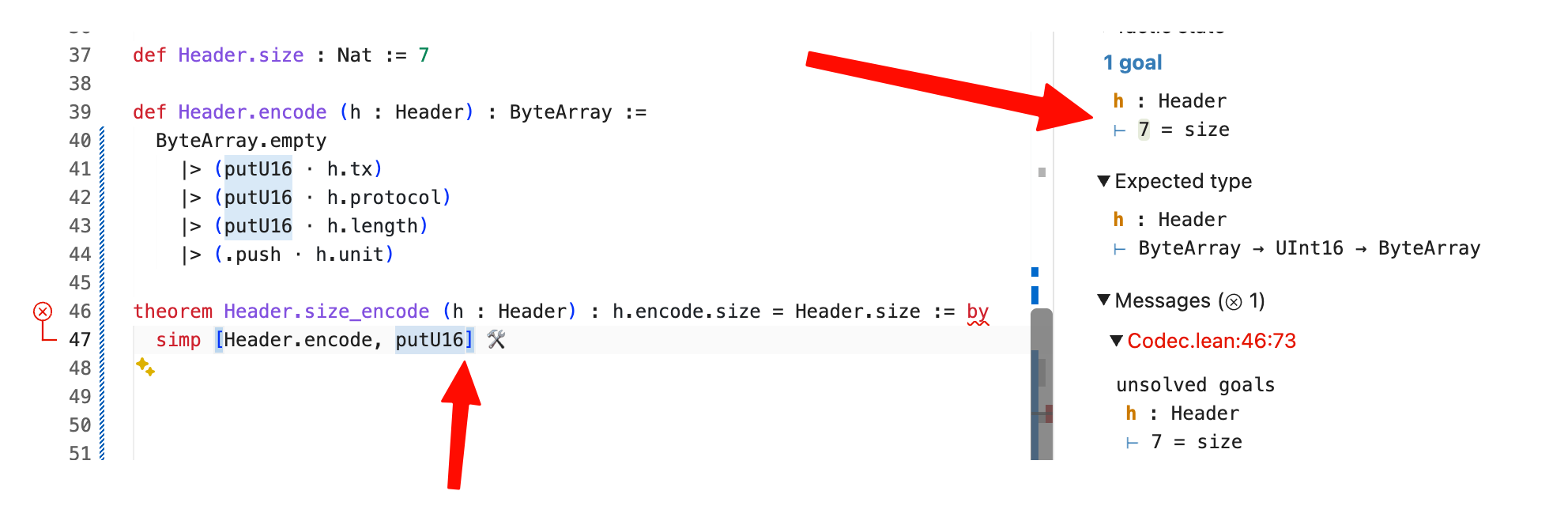
We literally defined Header.size := 7 and the goal is to prove that 7 = size, so it just needs one more nudge using
decide:
theorem Header.size_encode (h : Header) : h.encode.size = Header.size := by
  simp [Header.encode, putU16]
  decide
Success!
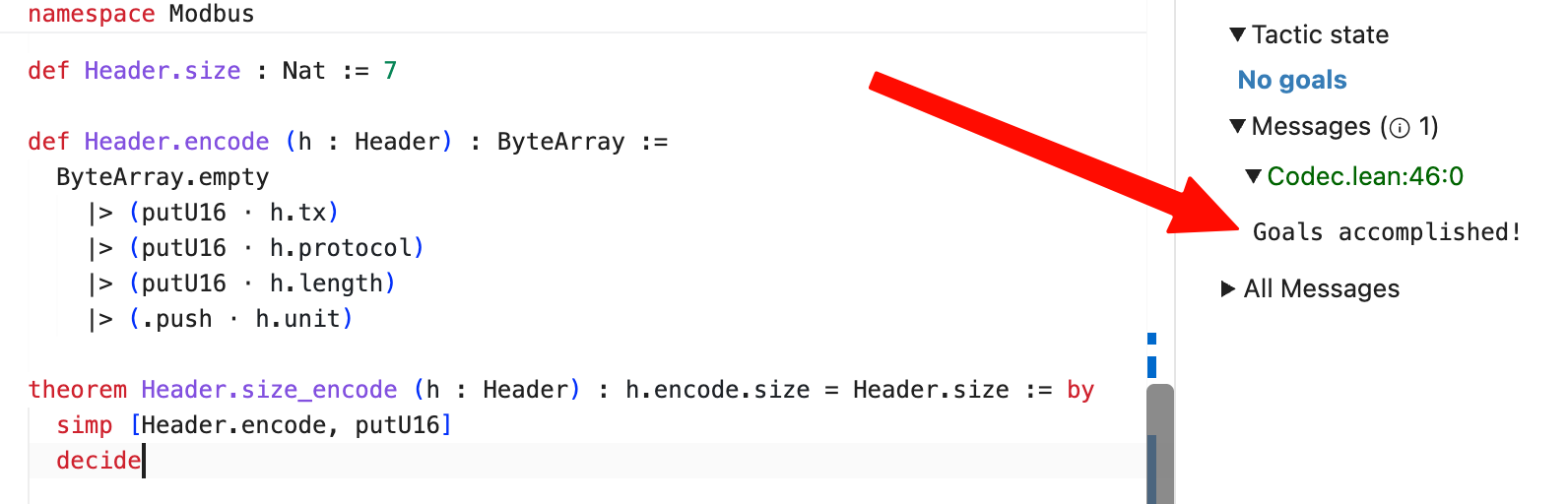
That’s pretty cool.
The rest of the codec is in https://github.com/carlohamalainen/sungrowd-lean/blob/main/Modbus/Codec.lean.
Reading U16 words and proving bounds Link to heading
Here’s a helper for reading 16-bit words from a ByteArray response that we received from the inverter:
def getU16 (b : ByteArray) (i : Nat) (h : i + 1 < b.size): UInt16 :=
  let vHigh := b[i].toUInt16
  let vLow  := b[i + 1].toUInt16
  (vHigh <<< 8) ||| vLow
The third argument to the function is a proof that i + 1 < b.size, which ensures that b[i + 1] is safe.
One of the most “exciting” bugs I saw in a C++ codebase at a previous job was
due to unsafe lookups into vectors (using x[i] instead of x.at(i)). The
function would work perfectly fine on any of 100 inputs individually, but if you
ran the 100 calculations in a sequence it would segfault. Some pushback from an older C++ person was that “using x.at(i) is slow”.
But in Lean this proof is checked at compile time and then erased, so the lookup compiles to a plain unchecked read.
This works:
#eval getU16 (ByteArray.mk #[0xAA, 0xBB]) 0 (by decide)but
#eval getU16 (ByteArray.mk #[0xAA, 0xBB]) 1 (by decide)produces an error:
Tactic `decide` proved that the proposition
  1 + 1 < { data := #[170, 187] }.size
is false
That’s fine for a static array and offset, but what about an offset into an arbitrary ByteArray?
In the checkWriteEcho function we are hoping for a ByteArray of size 5. The if statement
isn’t a normal boolean test like in other languages; it is a “dependent” if and the named
proof h : body.size = 5 is in scope for the then clause but not the else clause.
def checkWriteEcho (body : ByteArray) (addr : UInt16) (n : Nat) : Except Error Unit :=
  if h : body.size = 5 then
    if getU16 body 1 (by omega) = addr ∧ getU16 body 3 (by omega) = n.toUInt16 then
      .ok ()
    else
      let gotAddr := getU16 body 1 (by omega)
      let gotQty  := getU16 body 3 (by omega)
      .error (.protocol s!"write echo mismatch: got addr {gotAddr} qty {gotQty}, expected addr {addr} qty {n}")
  else
    .error (.protocol s!"write echo: expected 5 bytes, got {body.size}")
Compare
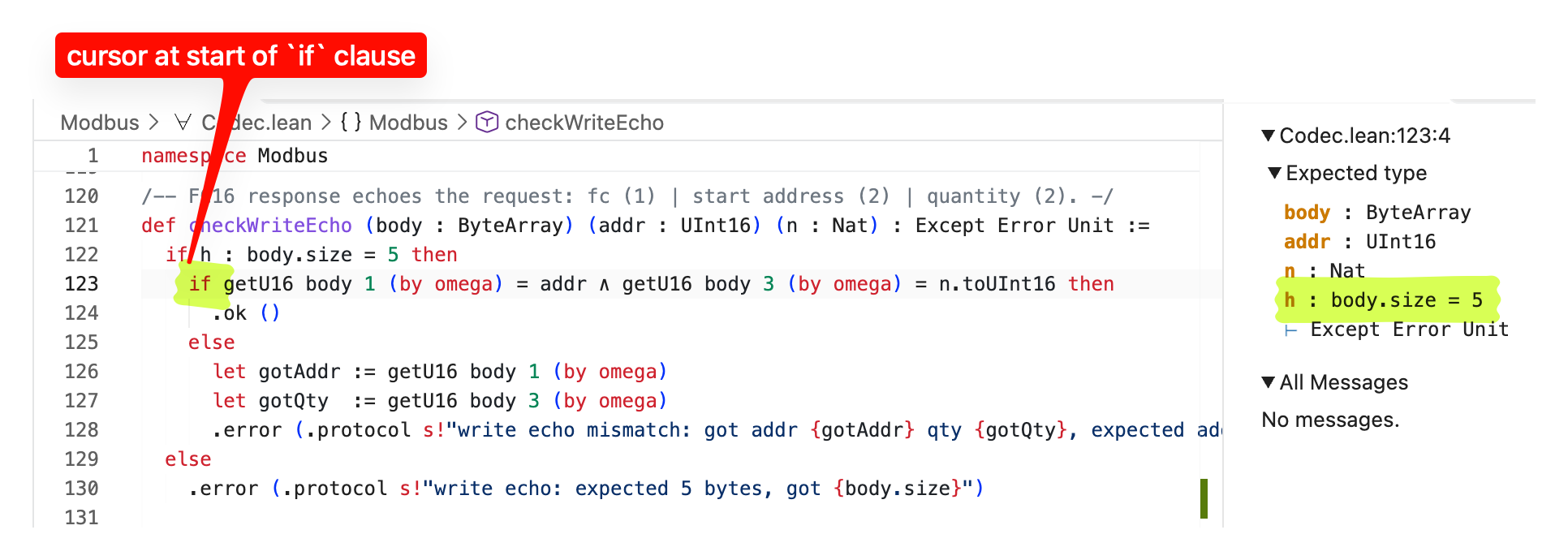
and
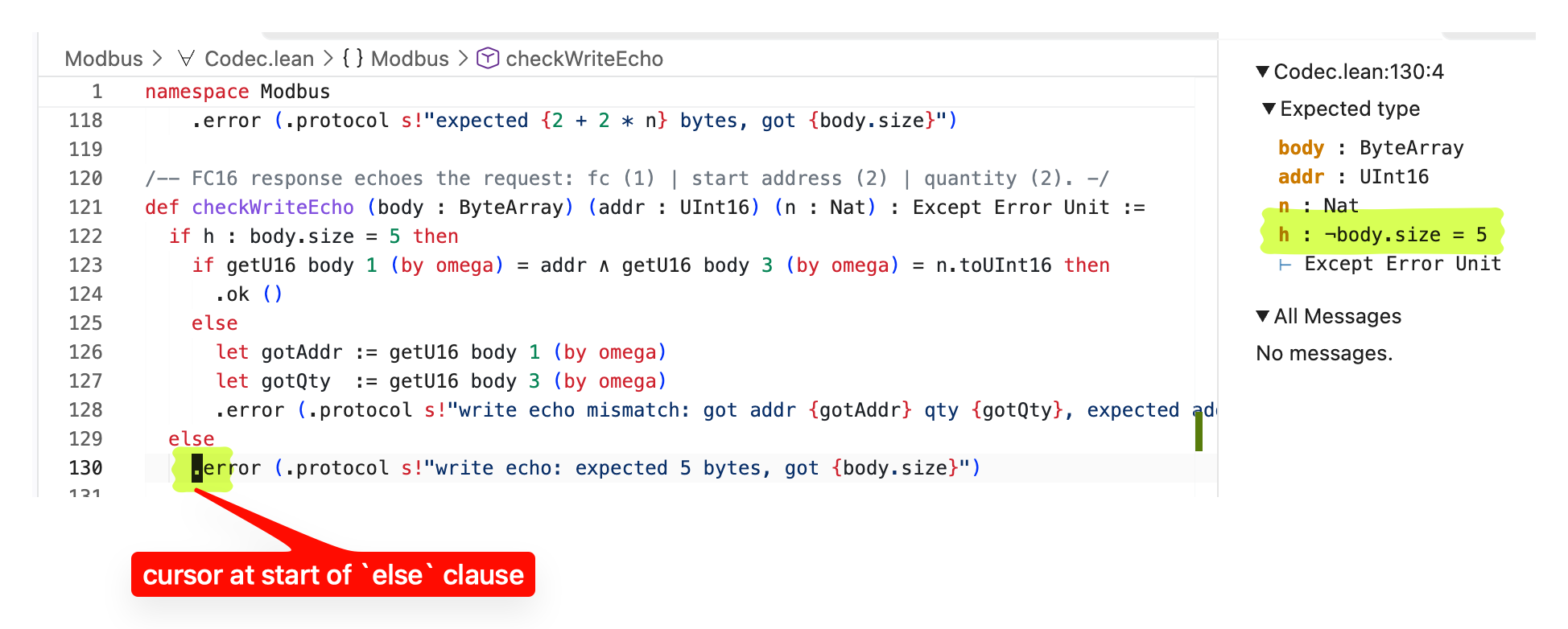
The Modbus protocol specifies that we can write at most 123 registers in a single request. We can encode this
as ValidWriteQuantity:
/-- Maximum number of registers that one FC16 write may carry (spec 0x7B),
so the byte count fits in a `UInt8`. -/
abbrev maxWriteQuantity : Nat := 123

/-- `n` is a legal register count for one FC16 write. -/
abbrev ValidWriteQuantity (n : Nat) : Prop := 1 ≤ n ∧ n ≤ maxWriteQuantity
I’ll skip the details of constructing the raw request, and just mention that the high level function for writing multiple registers can be sure that its supplied vector of values is within the acceptable size (see Client.lean):
def Client.writeMultipleRegisters (c : Client) (addr : UInt16) (vals : Vector UInt16 n)
      (hn : ValidWriteQuantity n := by first | omega | decide) : M Unit := do
  let body ← c.request <| writeMultipleRequest addr vals
  ofExcept (checkWriteEcho body addr vals.size)
We get an error if we try to pass an empty vector:
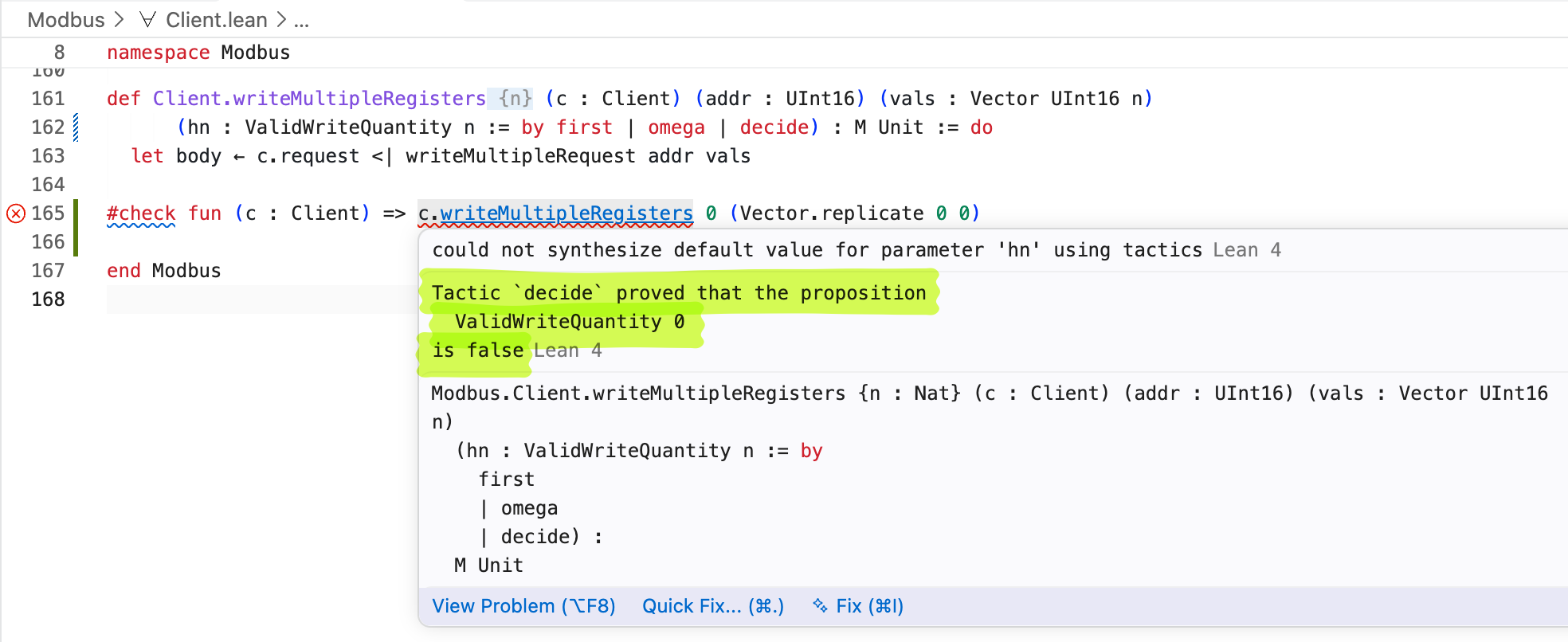
Calls with a vector in the correct range work, for example
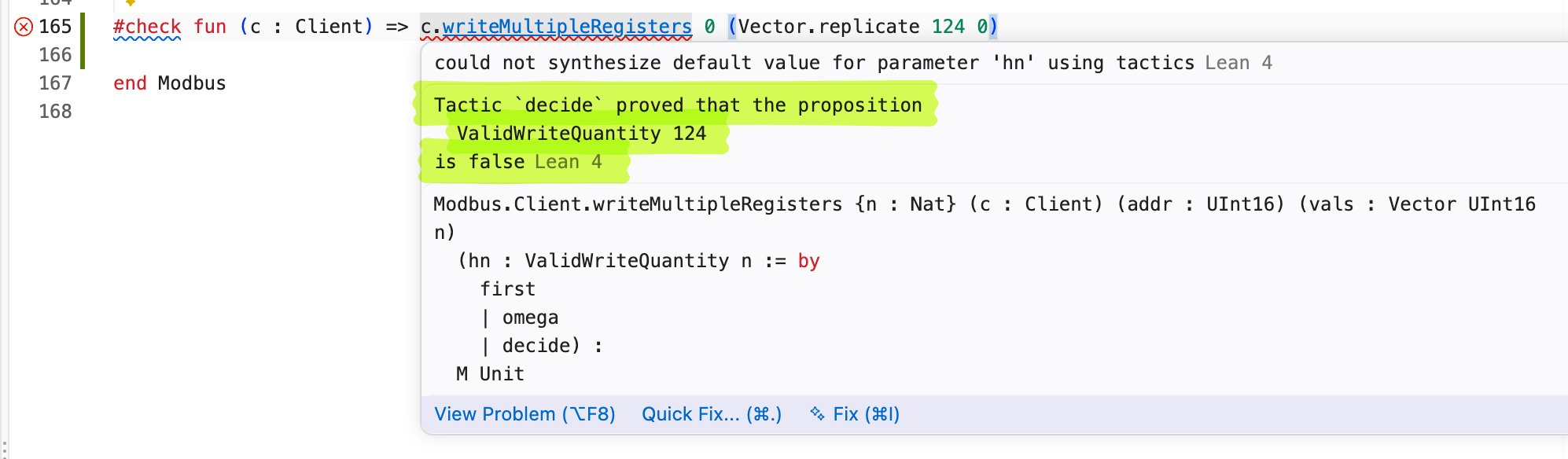
#check fun (c : Client) => c.writeMultipleRegisters 0 (Vector.replicate 100 0)And if we go over, error:
Reading a live value Link to heading
In Main.lean we read register 5007 which has the inverter’s temperature in degrees Celsius, signed 16-bit, with one implied decimal.
It works 🙂
❯ lake build && SUNGROWD_DEBUG=1 .lake/build/bin/sungrowd
Build completed successfully (8 jobs).
TX 00 00 00 00 00 06 01 | 04 13 8f 00 01   mbap tx=0 len=6 unit=1
RX 00 00 00 00 00 05 01 | 04 02 01 60   mbap tx=0 len=5 unit=1
inverter temperature: 35.2 °C  (raw 352)
Next steps Link to heading
The Modbus layer is done, so the next part moves up a level to the Sungrow-specific code:
- Named registers. Replace raw addresses with a typed register table, so reading the battery state of charge or the grid power is a function call rather than a magic number. The addresses come from the same HomeAssistant YAML that the Go version used.
- Typed control values. The battery command register takes one of three magic values for charge, discharge and stop. These can be encoded as an inductive type with a round-trip theorem.
- Testing writes against the real inverter. The write echo check from this post is the safety net. The next part will test writes on the control registers (EMS mode, command, forced power).
- Chunked reads. The Go version groups contiguous registers into blocks to cut down on round trips; the Lean version will do the same, with the block sizes proved valid.
Comment form pending Cloudflare verification...
Loading comments…